“You should not be prompting Claude, you should be building systems that prompt Claude.”
Orchestration Overhead
I noticed that I was spending time arranging handovers between agents to get access to fresh context windows. After a time I started writing scripts to launch agent harnesses in sequences. Many of us have gone this route, building personal tooling for agent orchestration. Gantry is my version of that.
I have several friends who have their own personal meta-harnesses that work really well and Gantry is inspired by these private tools much more than by any commercial service or open source project.
All agentic orchestration tools are shop jigs at this point. At some point standardized tools take shape, but that's not the stage we are at with agent orchestration tools.
“And now we’re back to hyper-waterfall … I’m not ruling out that there’s some magician out there who can actually make that work.”
Meta-Harness for Hyper-Waterfall
Gantry is built to support so-called spec-driven development with extensive upfront planning and long-running autonomous execution. Whenever you would launch a large number of subagents, consider using Gantry for a more structured approach.
Gantry provides rich interfaces for keeping track of agents and directing them during ongoing runs. But if your style of working is being in the loop, reviewing the work of agents step by step, Gantry is not for you.
Gantry does not provide a workflow for making plans. You can do it with the built-in assistant system, but the creator of Gantry mostly uses Claude Code running Fable and Opus to do analysis and planning. Gantry comes into the picture once the plan is done, i.e. when most of your work is done. Once you hand it to Gantry, it runs itself for a long time and only stops to contact you if it runs into something serious that multiple trouble-shooting agents have failed to resolve.
Patterns for agent sequencing
The key idea as I take it, is to avoid focusing on agent handovers, loop scripts etc, instead I use ready-made patterns implemented in Gantry's control flow:
Break big plans into milestones, then milestones into sprints.
Build->Test->Review loops with agents dispatched to fix problems or replan as needed.
Map jobs where agents execute the same prompt over some iteration.
Loop jobs where I define a goal and the entire Gantry plan-build machinery runs again and again until the goal is achieved.
Experimental control flows for other purposes.
What has Gantry actually worked on?
At the time of this writing, I have used Gantry in 17 code bases. 203 jobs have run from start to finish, inlcuding 96 for developing Gantry itself. 42 in a procedural music generator I am working on, 16 in a complex Rails app, 11 in a Godot game and 8 in an investigative journalism project.
Over the 203 runs, 10,680 agents have been launched, 59.2 million output tokens have been generated and 22,831 file edits have been made. In total agents have been running for 630 hours.
-
 Stats
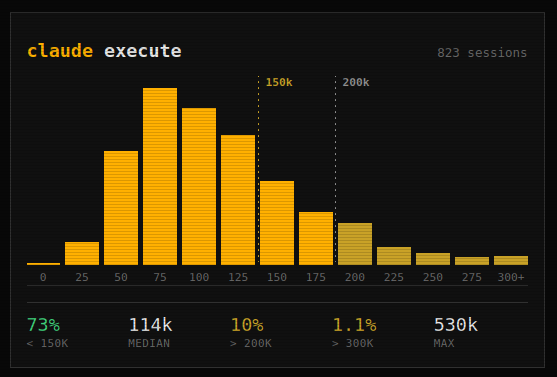
The creator of Gantry collects statistics on his own Gantry jobs and presents them here, to give an idea about how Gantry performs in real-life situations.
Stats
The creator of Gantry collects statistics on his own Gantry jobs and presents them here, to give an idea about how Gantry performs in real-life situations.
-
 Replay
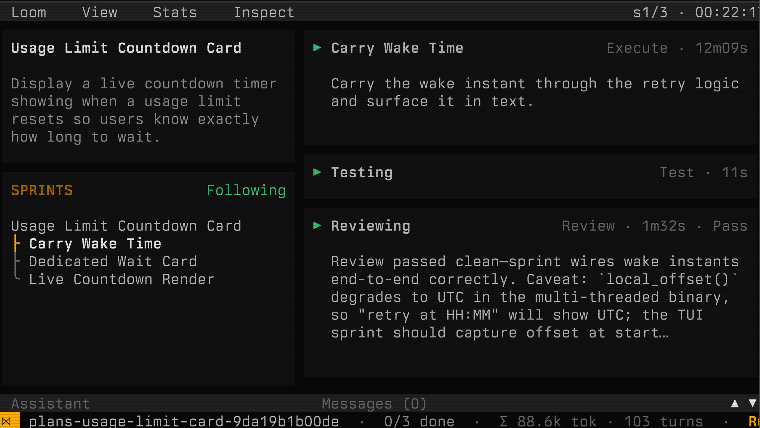
Gantry jobs generate detailed logs, which can be used to replay them. On this page a number of such jobs are presented, as screencasts and case studies.
Replay
Gantry jobs generate detailed logs, which can be used to replay them. On this page a number of such jobs are presented, as screencasts and case studies.